


Punjab Water Resources Minister Barinder Kumar Goyal today stated that there has been a significant improvement in the state’s groundwater level. He said that according to the latest assessment for 2026 released by the Central Ground Water Board, the groundwater level in the state has improved for the first time in decades. He said that the rate of groundwater exploitation has decreased from 164 percent in 2022 to 152.22 percent in 2026, while the number of over-exploited blocks assessed has decreased from 117 to 110 and the number of safe blocks has increased from 17 to 20.
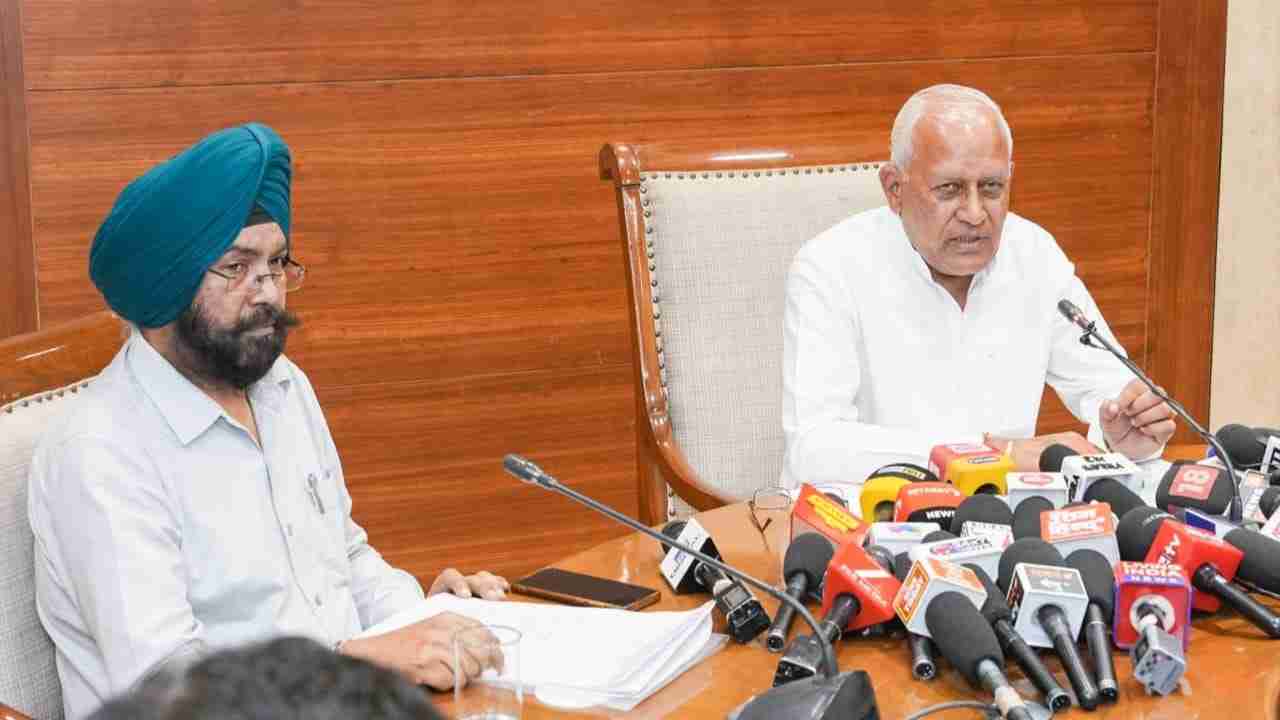
Addressing a press conference at Punjab Bhawan here, Water Resources Minister Barinder Kumar Goyal said, “ The improvement recorded in the latest assessment released by the Central Ground Water Board is a direct testimony to the concerted efforts being made by the Punjab Government led by Chief Minister Bhagwant Singh Mann to conserve groundwater by diverting canal water to the fields. ”
The Water Resources Minister said that the latest groundwater data demonstrates the significance of our efforts. He said, “The annual rate of groundwater extraction has declined from 28.02 billion cubic meters (BCM) in 2022 to 26.32 billion cubic meters (BCM) in 2026, while the overall groundwater level has also shown significant improvement.”
Minister Barinder Kumar Goyal said, ” This is a major achievement for Punjab. Groundwater levels have been steadily declining for decades. This is the first time we have recorded an increase. “
He said that 153 groundwater blocks in Punjab have been classified as safe, semi-critical, critical, and over-exploited. “As per the latest assessment, many blocks that were previously in the over-exploited and critical categories have shown improvement in water levels and have moved into better categories,” he said.
Giving information about the improvement in water level, the Water Resources Minister said that compared to the year 2025, 14 blocks have come in the better category, out of which four blocks have come in the safe category.
According to the report, Arniwala Sheikh Subhanpur in Fazilka has moved from the semi-critical to the safe category, with groundwater extraction rates declining from 73.34 percent in 2025 to 64.38 percent in 2026. Makhu in Ferozepur has moved from the semi-critical to the safe category, with groundwater extraction rates declining from 77.85 percent to 66.82 percent. Similarly, Hajipur in Hoshiarpur has moved from the semi-critical to the safe category, with water extraction rates declining from 81.67 percent to 62.16 percent. Narot Jamal Singh in Pathankot has moved from the semi-critical to the safe category, with water extraction rates declining from 70.94 percent to 66.47 percent.
Similarly, the classification of the remaining 10 blocks has also improved. Ferozepur has moved from severe to semi-critical, with groundwater extraction rates declining from 94.49 percent to 76.66 percent; Mamdot has moved from severe to semi-critical, with groundwater extraction rates declining from 99.85 percent to 86.59 percent; Gurdaspur has moved from over-exploited to severe, with groundwater extraction rates declining from 110.70 percent to 92.93 percent; and Kahnuwan has moved from over-exploited to severe, with groundwater extraction rates declining from 101.04 percent to 98.01 percent.
Similarly, Sri Hargobindpur has fallen from ‘severe’ to ‘semi-critical’ category as the water extraction rate has declined from 95.53 per cent to 75.54 per cent; Bhunga has fallen from ‘severe’ to ‘semi-critical’ category as it has declined from 92.14 per cent to 84.17 per cent; Hoshiarpur-2 has fallen from ‘severe’ to ‘semi-critical’ as it has declined from 97.81 per cent to 78.53 per cent; Mahilpur has fallen from ‘over-exploited’ to ‘severe’ as it has declined from 109.86 per cent to 92.23 per cent; Kot Ise Khan (Dharamkot, Moga) has fallen from ‘over-exploited’ to ‘severe’ as it has declined from 114.32 per cent to 97.67 per cent; and Aoud block of SBS Nagar has fallen from ‘severe’ to ‘semi-critical’ as it has declined from 90.84 per cent to 89.91 per cent.
Barinder Kumar Goyal stated that the other 95 blocks have also shown improvements at various levels. As a result, 109 of the 153 assessed blocks in the state have shown improvement in groundwater status, which he described as a major achievement for the state.
Out of these 95 blocks, three blocks have recorded improvement of more than 30 per cent, seven between 20 per cent and 30 per cent, 23 between 10 per cent and 20 per cent, while 62 blocks have recorded improvement between 0 per cent and 10 per cent.
The Water Resources Minister stated that this improvement in the groundwater situation in Punjab has been possible due to the combined efforts of increasing groundwater recharge and reducing water extraction rates. He said, “Optimized canal water utilization, renovation and expansion of irrigation infrastructure, water conservation and recharging measures have collectively contributed to this positive change.”
The state’s groundwater conservation efforts have been further strengthened by large-scale restoration and renovation of canals, repair and expansion of khals, laying of pipelines and ensuring supply of canal water to every farm located on the hills.
Cabinet Minister Barinder Kumar Goyal said, “Our objective was clear: to bring canal water to farms so that farmers don’t have to rely solely on groundwater. This isn’t just an irrigation initiative; it’s also an effort to secure Punjab’s water reserves for future generations.”
Canal water use increased from 26% to 82%
He said that the groundwater situation had become quite alarming over the past years as the groundwater level in Punjab was continuously falling. He added, “Therefore, the Punjab government adopted a concrete strategy to increase the use of available canal water and strengthen the canal network across the state.”
Water Resources Minister Barinder Kumar Goyal said that canal water use, which was only about 26 percent by 2022, has now increased to 82 percent. He said, “ To bring about this major change, the Punjab government has spent about 7,500 crore rupees and thousands of kilometers of khals and other irrigation infrastructure have been constructed and strengthened. ”
He said that the proper utilization of Punjab’s share of water stored in the state’s reservoirs was also made a key priority. He added, “Punjab has 1,117 canals and minors, which were previously being utilized far below their original capacity.”
Minister Barinder Kumar Goyal said that although the canal system has a water carrying capacity of about 36,000 cusecs, Punjab has been regularly supplying about 39,000 cusecs of canal water since June 1 this year. He said, “The increased availability of canal water has enabled farmers in many areas to cultivate paddy using canal water instead of extracting groundwater through tube wells.”
Directly delivering canal water to farms has simultaneously helped conserve groundwater and reduce electricity consumption, resulting in a reduction in dependence on groundwater extraction, resulting in power savings of approximately 16 percent in the state. Cabinet Minister Barinder Kumar Goyal said, ” When canal water reaches farmers’ fields, it not only saves groundwater but also reduces electricity consumption for pumping. This has proven to be beneficial for both farmers and Punjab’s water resources. “
The Water Resources Minister said that farmers are now benefiting significantly through improved availability of canal water for crops and the consumption of electricity for groundwater extraction has also reduced.
Over 510 groundwater recharge schemes underway in Punjab
He said that increased groundwater recharge has also contributed significantly to this improvement, with over 510 recharge schemes operating across the state. He said, “These include recharge through ponds, canal-based recharge structures, and Khambati wells. Together, these schemes have contributed to the recharge of approximately 38 lakh cubic meters of groundwater, which is more than the storage capacity of the Siswan Dam.”
Cabinet Minister Barinder Kumar Goyal said that the steps taken by the Punjab Government will further strengthen the conservation of groundwater and help in reducing the rate of groundwater extraction in the coming years.
He emphasized that conserving groundwater is not just an environmental necessity for Punjab, but is directly linked to the nation’s food security. Cabinet Minister Barinder Kumar Goyal said, “Punjab contributes significantly to the central food reserves and has historically played a key role in ensuring the nation’s food security. Therefore, protecting groundwater is directly linked to safeguarding the nation’s food security.”
Punjab Government committed to conservation of water resources
He said that if the alarming groundwater depletion continues unchecked, it could pose a serious threat not only to Punjab’s agricultural economy but also to national food security. He added, “Therefore, the Punjab government has taken decisive steps to conserve the state’s water resources to ensure the protection of the interests of future generations.”
The Water Resources Minister said the latest groundwater data are encouraging for Punjab and strengthen the government’s resolve to further expand canal irrigation and groundwater conservation measures. He added, ” The Punjab Government, under the leadership of Chief Minister Bhagwant Singh Mann, is committed to sustainable water management and securing the state’s agricultural future. “
On this occasion, senior officers of the Water Resources Department including Sher Singh, Chief Engineer (Canal and Ground Water), Manoj Bansal, Supervising Engineer (Ground Water) were present.